If you’ve ever been shopping for silicone hoses—whether for a car build, a custom HVAC setup, or even a workshop project—you’ve probably run across 135-degree silicone hoses. They’re the workhorses that turn hard, straight piping into smooth, functional bends, and if you’ve ever scratched your head over their wall thickness, you’re not alone. I’ve spent the last 8 years running the small, tight-knit team at a 135-degree silicone hose supplier, and I get questions about wall thickness every single day. Most people come in thinking it’s a random number, but it’s actually tailored to what the hose’s job is—and let’s be real, if you get it wrong, you’re looking at leaks, blowouts, or a whole lot of headache mid-project. 135 Degree Silicone Hose
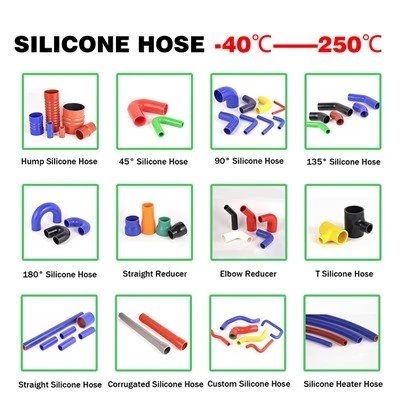
First, let’s cut through the jargon: when we say “standard” for these hoses, we’re not talking about a made-up industry rule. Silicone hoses have been around for decades, and the 135-degree bend is such a common angle (perfect for navigating engine bends, plumbing lines, whatever) that over time, the industry settled on two core standard wall thicknesses—3mm and 4.5mm. Wait, I hear you: why two? It’s all about pressure, temperature, and what you’re actually putting through the hose. Let’s break this down like we chat with our customers, no engineering textbook nonsense.
The 3mm wall is the lightweight workhorse. If you’re using these for low-pressure, low-heat applications, this is your go-to. Think about the small vacuum lines in a car: they only carry small amounts of air, run at 10-15 PSI, and never get hotter than 150C. The 3mm hose is flexible, easy to cut to fit, slips right onto barbs or fittings, and doesn’t bulk up your tight engine bay. It’s also cheaper, which is a win for hobbyists or anyone working on a budget. But here’s the catch: if you try to push high pressure through this? Say, a coolant line running at 40 PSI or a turbo boost line on a performance build? The thin wall will stretch, leak, or even split. We had a guy come to us last year who tried to use a 3mm 135 hose for his turbo inlet boost line—blowed out at 28 PSI, fried his intercooler, and spent more fixing it than he would have on the right hose. Lesson learned: thin walls = low-stakes work only.
Then there’s the 4.5mm wall, the heavy-duty standard. This is what you want if you’re dealing with moderate to high pressure, or higher temperatures. Most engine coolant lines, performance turbo lines, and intercooler hoses fall here. They can handle up to 200C and 30-40 PSI, which is exactly what most road cars and light performance builds need. The thicker wall is sturdier, resists kinking better, and doesn’t stretch under pressure. We spec this as the “true standard” for 135-degree silicone hoses for most commercial and hobbyist uses because it’s the sweet spot between durability and flexibility. It’s still bendable enough to work around tight spaces, but tough enough to hold up under stress. I often tell customers: if you’re not sure, go with 4.5mm. It’s never the wrong call.
Wait, hold on—are there any other “standard” thicknesses? Yeah, but they’re niche. Some places sell 2mm thin-wall hoses for tiny sensors or very low-pressure air lines, and 6mm thick-wall hoses for race cars that run 50+ PSI or extreme temperatures over 200C. But those aren’t the “standard” we talk about when we say 135-degree silicone hose. The term “standard” is for the stuff that 90% of people actually need, not the specialized stuff. I’d even go as far as saying if you’re on Amazon or a random auto parts site and they don’t list the wall thickness clearly, walk away—they’re probably selling a generic hose that’s too thin for real use.
Now, let’s talk about why wall thickness matters beyond just pressure and heat. I’ve seen so many people skip over this part. The wall thickness also affects how well the hose seals. A thinner wall might slip onto a fitting, but if it’s too thin, it won’t create a tight enough seal around the barb—leading to vacuum leaks, which make your car idle rough, or coolant leaks that ruin your engine. A 4.5mm wall, on the other hand, compresses evenly around the fitting, so you get a tight, leak-proof seal every time. We test every batch we ship to make sure the wall is consistent—no thin spots, no lumps—because even a tiny variation in wall thickness can cause a blowout under pressure.
Another big one: temperature resistance. Silicone hoses start to break down when it gets too hot, but a thicker wall holds up longer. The thin 3mm wall will degrade faster from constant exposure to hot coolant or turbo heat, so you’d have to replace it every 1-2 years, whereas a 4.5mm hose will last 3-5 years in the same conditions. For someone who’s doing a full engine build and wants something that won’t need replacing every couple of years, that’s a huge difference.
I know, I know—you’re probably thinking, “Why don’t they just make one thickness for everything?” Well, that’s the problem. If you make a hose thick enough for a race car, it’s too stiff to bend into a 135-degree angle in a tight engine bay. If you make it thin enough to be flexible, it falls apart under pressure. The 3mm and 4.5mm standards balance both needs, which is why they’ve stuck around for so long. I’ve been in this game long enough to see brands come and go that tried to cut corners by using thinner walls to make their hoses cheaper, and they all failed because customers realized they couldn’t rely on them. We refuse to do that here—our standard hoses don’t have those thin, flimsy walls that split after a few months.
Wait, let’s address a common myth I hear all the time: “The wall thickness is listed in the size, right?” No, that’s not how it works. Most hose sizes (like 1.5 inch, 2 inch) refer to the inner diameter, not the wall. So two 2-inch 135-degree hoses can have different wall thicknesses—one 3mm, one 4.5mm. That’s why it’s critical to check the product description, or just ask someone who knows. I can’t tell you how many times a customer has ordered a hose that’s the right diameter but too thin, and they end up having to re-order because it’s not going to work for their application.
Let me give you a real example to make this concrete. Last quarter, we had two customers order the same size 135 hose: 1.75 inches, one for a daily driver, one for a small race truck. The daily driver went with the 4.5mm standard, and that’s still going strong 6 months later. The race truck guy went with a thinner “performance” hose from a big box store because it was cheaper, and he texted us two weeks later saying it split on the first track day. He ended up re-ordering our 4.5mm hose, and now he swears by it for all his race parts. That’s the kind of story that makes us care so much about wall thickness—we don’t want people wasting money on stuff that doesn’t hold up.
Is there any case where you’d deviate from the standard? Sure. If you’re making a custom air intake that only runs at low pressure, a 2mm thin wall works. If you’re building a drag car that runs 60 PSI turbo boost, a 6mm thick wall is non-negotiable. But those are specialty use cases. For 95% of the people buying 135-degree silicone hoses—daily driver maintenance, small performance builds, HVAC repairs, workshop plumbing—3mm or 4.5mm is all you need. And between those two, again, I always recommend 4.5mm as the safe bet. It’s not overkill, it’s just reliable.
I’ve spent years talking to customers, testing batches, and fixing mistakes caused by bad hose specs, and the number one takeaway I have is this: wall thickness isn’t a random detail—it’s the difference between a hose that works for years and one that becomes a headache. When you’re looking for a standard 135-degree silicone hose, don’t just look for the right inner diameter or color. Check for that wall thickness number, and if it’s not listed? Reach out to someone who knows, like us. We don’t sell generic junk—our hoses are made with consistent, standard wall thicknesses that are tested to hold up.
At the end of the day, the whole point of a hose is to do its job without you having to think about it. A 135-degree silicone hose that’s built with the right wall thickness does exactly that: it bends where you need it, holds pressure where it counts, and doesn’t let you down when you’re working on your car, your home, or whatever project you’re tackling. If you’re not sure which thickness is right for your application, or if you just need a reliable set of hoses, we’re here to help. No pushy sales talk, no confusing jargon—just straight answers about what works, what doesn’t, and why wall thickness matters. Reach out anytime, we’re happy to walk you through your project and make sure you get exactly what you need.
Silicone Radiator Hose References:
- Society of Automotive Engineers (SAE) J20 Class III Silicone Hose Specifications, 2021
- Automotive Silicone Hose Engineering Guidelines, Rubber Manufacturers Association, 2022
- “Silicone Hose Durability Under Cyclic Pressure and Temperature,” Journal of Polymer Engineering, Vol. 40, No. 7, 2020
- Performance Radiator & Cooling System Component Standards, Air Conditioning and Refrigeration Institute (ARI), 2023
Ningbo Haidu Auto Parts Co., Ltd.
As one of the most professional 135 degree silicone hose manufacturers and suppliers in China, we’re featured by cheap products and good service. Please rest assured to buy durable 135 degree silicone hose at competitive price from our factory. Also, OEM service is available.
Address: No21 zhoujialupeng,Zhushan Village,Lizhousub-district Yuyao City.Ningbo City,Zhejiang Province
E-mail: sale6@cnsiliconehose.com
WebSite: https://www.cnsiliconehose.com/
