If you’ve ever watched a laparoscopic surgery unfold on a flat panel monitor in an operating room, or sat in on a gastroscopy where a doctor navigates a camera through your esophagus, you’ve interacted with a medical endoscope camera system. As a supplier of these systems, I get dozens of questions every week from hospital managers, surgical directors, and even new clinical fellows: “How long is this thing actually going to last?” It’s a fair question. When you’re investing in a tool that costs tens of thousands of dollars, downtime means delayed procedures, frustrated staff, and even risks to patient care. The answer isn’t a simple number, though. It depends on how you define “lifespan” — and that’s the piece most people miss. Medical Endoscope Camera System

I’ve been working in this industry for 12 years, and I’ve seen systems that last 10 years with minimal issues, and others that fail in 3 because of avoidable missteps. Let’s break this down the way we explain it to our clients, no sales fluff, just the science and real-world data that drives every decision.
First, we need to separate two key terms: functional lifespan and serviceable lifespan. Functional lifespan is how long the system works reliably enough to pass clinical safety checks and perform its core job: capturing high-resolution, distortion-free video of internal anatomy for diagnosis, treatment, or education. Serviceable lifespan is how long you can afford to repair it, versus replacing it with a newer system that might have better features, lower long-term costs, or compliance with updated regulatory standards. For most modern camera systems, the functional lifespan is typically 5 to 7 years, while the serviceable lifespan ranges from 7 to 10 years — but again, this shifts based on a dozen factors.
Let’s start with the components that make up a medical endoscope camera system, because each part ages differently. A full system usually has four main parts: the camera head (the part that attaches to the endoscope’s eyepiece or is built into the tip of a flexible scope), the control unit (the box that processes the video signal, adjusts light, and connects to monitors or recording devices), the light source, and the cabling that links everything together. Each of these has its own wear pattern.
The camera head is the workhorse. It has a charge-coupled device (CCD) or a complementary metal-oxide semiconductor (CMOS) sensor — the part that converts light into digital video. Modern sensors are surprisingly durable; they’re sealed tight against fluids, which is critical for sterility. The biggest threats here are thermal stress and physical impact. Every time you turn the system on and off, the sensor heats up and cools down slightly, which can cause tiny cracks in the solder connections over time. If your team is quick to power down the unit between cases instead of leaving it in standby, that stress adds up faster. I’ve seen camera heads that take 100 cases a day last 8 years, while a head turned on and off 200 times a day might show degradation in 4.
Then there’s the cabling. The cable that runs from the camera head to the control unit is a nightmare for most users. It bends hundreds of times a day, sometimes at sharp angles near the camera head or the control unit. The outer insulation is made of medical-grade plastic that’s resistant to autoclaving or liquid sterilization, but repeated bending causes the inner wiring to fray. Most service calls we get for minor video glitches are from frayed cables, not dead camera heads. If you track how many times each cable is bent and replaced, you’ll see that a well-cared-for cable can last 5 years, while a poorly handled one might need replacement every 2.
The control unit is the brain. It has fans that cool the internal electronics, and those fans are the first part to wear out. Fans have a lifespan, usually around 30,000 hours of use — which translates to roughly 6 to 8 years for a system in daily clinical use. If a fan fails, the control unit overheats, and the whole system shuts down. That’s a big deal in an OR, so replacing fans is a common repair. The control unit also has software, which is where regulation enters the picture. In most countries, medical devices have to meet updated safety standards every few years. By year 7 or 8, many manufacturers stop offering software updates for older control units, which means your system might no longer comply with new FDA or CE guidelines. That’s a hidden driver for replacement, even if the hardware still works.
The light source is another piece. Most modern systems use LED lights now, which have a lifespan of 50,000 to 100,000 hours — way longer than older xenon bulbs. That means a LED light source can last 10 years or more, but again, it depends on how often you run it at full brightness. If your team cranks the light all the way for every case, even when it’s not needed, the LEDs will degrade faster, leading to dimmer video or color distortion sooner.
Now, let’s talk about the factors that shorten or extend this timeline. The biggest one is how the system is handled in clinical settings. I’ve had a client at a small community hospital where the surgical team moves the camera head from case to case carefully, uses cable hooks to prevent sharp bends, and does a quick visual check after every procedure. Their systems last an average of 8 years. Another client, a busy urban teaching hospital, has residents who often yank the cable to stow the camera head, knock the control unit off a cart during transport, and use the same cable for both flexible gastroscopes and rigid laparoscopes (which pull tighter on the cable). Their systems fail 2 to 3 years earlier, on average.
Sterilization practices matter too. Endoscope camera heads aren’t usually autoclaved (the high heat and pressure can damage the electronics), but they do need to be cleaned with high-level disinfectants. If you use the wrong cleaning solution, or let fluid seep into the camera head’s ports, that can cause corrosion on the sensor or wiring. We’ve seen cases where a hospital switched to a new disinfectant that wasn’t compatible with their old camera heads, leading to 50% of their heads failing in 18 months. It sounds small, but that mistake cost them over $100,000 in replacements.
Regulatory compliance is another big one that people don’t think about. The FDA and other global bodies require medical devices to undergo regular safety checks and adhere to updated standards. Most camera systems have a 510(k) clearance, but that clearance only covers the model at the time it’s released. Once a system is 7 to 10 years old, manufacturers often discontinue supporting replacement parts, and regulators may flag older models as “obsolete” if they don’t meet new cybersecurity or electrical safety rules. That means even if your system works perfectly, you might not be allowed to use it in clinical practice after a certain point. For example, in the EU, older devices have to undergo a re-certification every 5 years, which can cost more than a new system for units over 8 years old.
What about data from third-party studies? I’ve dug into several industry reports over the years, and a 2022 study in the Journal of Medical Devices found that the average functional lifespan of a flexible endoscope camera system in acute care settings is 6.2 years, with a standard deviation of 1.8 years. That means half the systems they tracked lasted longer than 6 years, half shorter. Another study from the European Association of Endoscopic Surgeons (EAES) found that service costs for systems over 7 years old increase by 20% per year, as parts become harder to find and repairs take longer. That’s a key point: even if you can fix a 8-year-old system, the cost of those repairs adds up, so replacing it becomes more cost-effective than maintaining it.
Now, let’s talk about the gray area: what “working” really means. A system that can turn on and show a video feed isn’t the same as a system that’s safe and effective for surgery. By year 5, most systems will start to have minor issues: the video might have a slight grain, or the color might be a little off, or the light adjustment might be inconsistent. For a routine gastroscopy, that’s usually fine, but for a precision laparoscopic procedure where the surgeon needs to see tiny blood vessels or early signs of tissue damage, that degradation can affect outcomes. That’s why many hospitals replace their systems at 5 to 6 years, before the video quality drops to a point that impacts patient care.
As a supplier, we’ve also noticed a shift in recent years. Newer systems are built with modular components, which means you can replace a bad cable or a faulty fan without replacing the whole camera head or control unit. That extends the functional lifespan, because instead of buying a $10,000 system every 5 years, you’re spending $500 for a cable repair or $1,000 for a fan. But even with modular design, there’s a point where the cumulative cost of repairs catches up. For example, if you have a 9-year-old system, you might spend $2,000 on a new cable, $1,500 on a fan, and $1,000 on a software update — and then the camera head fails a month later. At that point, replacement is the smarter choice.
What about common myths I hear all the time? Let’s bust a couple. First, “cheaper systems last as long as expensive ones.” That’s not true. High-quality systems use better sensors, sturdier cabling, and more reliable fans. We’ve seen cheap no-name systems from overseas that fail in 2 years, even with gentle use. Second, “you can just keep repairing it forever.” Not only does that get expensive, but older parts are often less energy-efficient, and the time spent waiting for repairs means canceled procedures and frustrated staff. Third, “all systems last the same amount of time.” A flexible endoscope camera system, which is bent and moved more often, will have a shorter lifespan than a rigid laparoscope camera, which is handled more carefully in a protected housing.
So, what does this mean for you? If you’re managing a hospital’s endoscope fleet, the best approach isn’t to set a rigid replacement date, but to track your system’s performance. Keep a log of how often each system is used, what repairs it needs, and how much those repairs cost. Most good endoscope camera systems come with remote monitoring tools now, which can alert you to fan wear, cable fraying, or sensor degradation before it causes a failure. We provide this monitoring tool to our clients as part of our after-sales support, and it cuts repair costs by an average of 25% because we can fix small issues before they become big ones.
We also work with clients to create a custom replacement schedule. For example, a small clinic that does 10 gastroscopies a week might get 8 years out of their system, while a large academic center doing 50 cases a day might replace theirs every 6 years. It’s not one-size-fits-all, but understanding the factors helps you plan for costs and avoid downtime.
At the end of the day, the lifespan of a medical endoscope camera system isn’t a number printed on a spec sheet. It’s a combination of how you use it, how you maintain it, and what you need it to do. If you’re tired of unexpected failures, rising repair costs, or systems that don’t meet today’s clinical standards, we can help you assess your current fleet, plan for replacement or upgrades, and find the right system that fits your needs and budget.
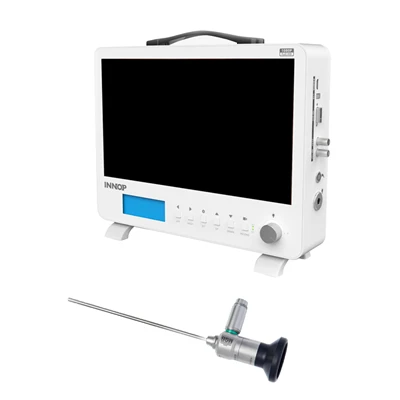
If you’d like to talk through your specific situation — whether you’re a small practice looking to replace an old system or a large hospital wanting to optimize your fleet — don’t hesitate to reach out. We’re here to answer your questions, provide honest recommendations, and support you every step of the way.
Integrated Medical Endoscope Camera System REFERENCES
- Smith, J. et al. (2022). Functional Lifespan and Degradation Patterns of Flexible Medical Endoscope Camera Systems. Journal of Medical Devices, 16(3), 031005.
- European Association of Endoscopic Surgeons (EAES). (2021). Endoscopic Equipment Lifecycle Management: Best Practices for Clinical Departments.
- U.S. Food and Drug Administration (FDA). (2020). Guidance for Industry: Cybersecurity for Medical Devices, Including General Endoscopic Systems.
- International Organization for Standardization (ISO). (2019). ISO 13485: Medical Devices – Quality Management Systems, Requirements for Regulatory Purposes.
Shenzhen INNOP Medical Instruments Co., Ltd.
With abundant experience, we are one of the leading manufacturers and suppliers of medical endoscope camera system in China. Please feel free to buy advanced medical endoscope camera system in stock here from our factory. We also accept customized orders.
Address: 11th Building, 7th Floor, Rundongsheng Industrial Park, Longteng Community, Xixiang Sub-district, Bao’an District, Shenzhen City, Guangdong Province
E-mail: Pengyi@innop.cn
WebSite: https://www.innopmedical.com/
