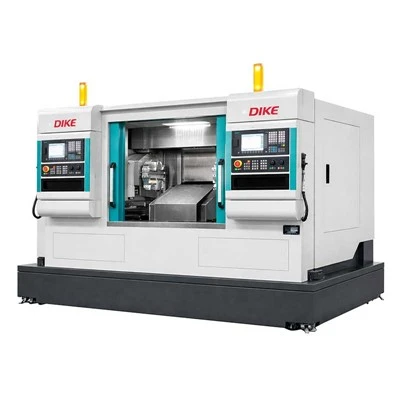
If you’ve ever worked in manufacturing, tool and die making, or field maintenance, you know the frustration of being tied to a fixed, large machine shop. Whether you’re repairing a broken component on an oil rig 100 miles from the nearest shop, machining a custom part for a vintage truck in a small garage, or performing on-site maintenance for heavy construction equipment, the inability to bring precision machining tools to the work site can add days or even weeks to a project—and thousands of dollars in additional costs. That’s where portable turning and grinding compound machine tools come in, a category of equipment designed to address exactly that gap. As a supplier specializing in these machines, I’ve spent years working with industry professionals to understand what they need, and I’m here to break down what these tools are, how they work, their key use cases, and why they’ve become an indispensable asset for so many operations. Turning and Grinding Compound Machine Tool

First, let’s clarify what a portable turning and grinding compound machine tool actually is. Unlike the fixed, multi-ton lathes and grinders you’ll find in a traditional machine shop, these systems are engineered to be disassembled, transported, and set up on-site, often with minimal heavy lifting or specialized tools. “Compound” here means they combine two core functions—turning (cutting, facing, or boring cylindrical parts) and grinding (finishing those parts to a precise, smooth surface)—into one portable unit, eliminating the need to move a single component between separate machines. For many field technicians, that’s a game-changer: turning a large shaft that can’t be removed from a machine into a task that takes hours instead of days, without the risk of damaging the part during transport.
A common misconception I’ve encountered over the years is that portable machines can’t match the precision of fixed shop equipment. That’s simply not true, thanks to advances in material science and control systems. Many of the portable turning and grinding systems we supply use precision linear guides and digital readouts that measure cuts to within 0.001 inches, meeting or exceeding industry standards for automotive, aerospace, and energy applications. Some models even have programmable controls, allowing technicians to input dimensions and let the machine adjust cuts automatically, reducing human error even when working in a remote environment.
Now, let’s talk about the most common use cases for these machines, because that’s where their value becomes tangible. One of the biggest industries relying on portable turning and grinding is oil and gas. Out in the field, on drilling rigs, pump jacks, and pipeline compressors, rotating components like shafts, bearings, and couplings wear out constantly. A broken shaft can shut down an entire rig, costing operators tens of thousands of dollars per day in lost production. Instead of removing the shaft, transporting it to a machine shop, waiting for repairs, and then reinstalling it, a technician can set up a portable compound machine directly on the rig, turn down a worn shaft to its original diameter, grind it to a smooth finish, and get the rig back online in hours. I recently worked with a major midstream energy company that used one of our systems to repair a 12-inch diameter pump shaft on a remote pipeline in West Texas; the entire job took 8 hours, compared to the 3 days it would have taken to send the shaft to a shop.
Another key use case is heavy equipment maintenance. Construction companies, mining operations, and agricultural businesses rely on large machinery—excavators, bulldozers, tractors, and haul trucks—that has components too big to move easily. When a crankshaft on a mining haul truck develops an out-of-round wear spot, or when the flange on a large drive shaft needs to be machined to fit a new coupling, a portable compound machine lets technicians perform the work on-site, avoiding the cost of renting a temporary shop space or transporting the entire 100,000-pound truck to a shop. We also supply a lot of these machines to automotive restoration shops; many vintage car parts, from engine crankshafts to wheel hubs, are too rare or too large to replace, so restoration technicians use portable turning and grinding to repair and finish parts without risking damage during transport.
Of course, not all portable turning and grinding machines are created equal, and there are a few key features to look for when choosing one, especially if you’re purchasing for frequent field use. First, portability is about more than just size; it’s about weight and ease of setup. A good portable machine should be easy to disassemble into components that one or two people can carry, since access to remote worksites is often limited. Many of the systems we offer break down into parts weighing 50 to 150 pounds, which is manageable for a two-person team, compared to older models that required a crane to move. Second, the compatibility with different workpieces is important. Some machines are designed specifically for cylindrical parts, while others can handle flat surfaces, internal bores, and even irregular shapes depending on the tooling. Look for a machine that comes with interchangeable tool holders and grinding wheels, so you can adapt it to different jobs. Third, power source is a critical factor for remote worksites. Many portable models run on standard 110V or 220V electricity, which is easy to access on most job sites, but some offer hydraulic or battery-powered options for areas with no grid power, like deep mines or off-shore rigs.
I’ve also learned over the years that training is a big part of getting the most out of these machines. A portable turning and grinding compound tool isn’t a set-it-and-forget-it device; it requires the operator to have a basic understanding of machining principles, like how to set cutting speeds, adjust for material hardness, and check surface finishes. That’s why we offer on-site training for all our customers, as well as online resources and user manuals designed for field technicians, not just professional machinists. We’ve seen too many cases where a company purchased a portable machine and tried to use it without proper training, leading to bad cuts or even damage to the machine or the workpiece. Investing in training pays off, though; it can reduce job time by 30% or more and ensure consistent, high-quality results.
Another point to consider is maintenance for the machines themselves. Portable tools are exposed to dust, dirt, temperature extremes, and rough handling on worksites, so they need regular upkeep to stay accurate. We provide our customers with a maintenance guide that includes steps like lubricating linear guides, checking calibration monthly, and storing the machine in a dry, climate-controlled space when not in use. We also offer replacement parts and repair services, so if a component wears out or gets damaged, you don’t have to buy a whole new machine.
Let’s address a common question I get from potential customers: is a portable turning and grinding machine worth the investment? For small operations, like a one-man restoration shop, the answer might be different than for a large construction company with multiple field teams. But let’s do a quick cost comparison. A fixed lathe capable of turning a 12-inch diameter shaft can cost $50,000 or more, plus the cost of transporting the workpiece to the shop and any downtime. A portable compound machine from our line costs a fraction of that, often between $5,000 and $20,000 depending on the size and features, and it pays for itself in a single job where you avoid downtime or shop costs. For example, a mining operation that loses $50,000 per day when a haul truck is down will recoup the cost of a portable machine in one successful on-site repair. Even for smaller operations, like a local garage doing trailer repairs, a portable machine can let you take on jobs you couldn’t before, like repairing large axle shafts, and charge more for that specialized work.
I should also mention some of the latest innovations in portable turning and grinding technology, because the industry hasn’t stood still in recent years. We now have machines with wireless digital readouts that connect to your phone or laptop, letting you track measurements in real time and save job records for quality control. Some models even have built-in vibration sensors that alert you if the machine is misaligned, which is a huge help for technicians working on uneven ground. We’ve also developed lightweight carbon-fiber components for some of our smaller machines, reducing weight even more without sacrificing strength, making them easier to transport to remote locations.
Of course, there are limitations to portable machines, and it’s important to be realistic about what they can do. They’re not designed for high-volume production runs, for example—they’re meant for one-off repairs, custom parts, and low-volume work. They also have size limits: most portable turning machines can handle parts up to 24 inches in diameter, though we do offer larger models for parts up to 48 inches. If you need to machine a part larger than that, a fixed shop lathe is still the best option. But for the majority of field maintenance and custom work jobs, portable machines are more than capable.
As a supplier, our goal isn’t just to sell a machine—it’s to provide a solution that makes our customers’ jobs easier and more profitable. I’ve worked with technicians who used to spend weeks waiting for repairs, and now they can get the job done in a day. I’ve seen companies reduce their equipment downtime by 70% after adding portable turning and grinding machines to their fleet. That’s the real value of these tools: they eliminate the barrier between the workshop and the worksite, letting you work faster, smarter, and more cost-effectively.
If you’re considering adding a portable turning and grinding compound machine to your operations, or if you have questions about which model is right for your specific needs, we’re here to help. We work with customers across industries, from oil and gas to automotive restoration to heavy construction, and we can customize a solution to fit your budget and use case. Whether you’re a small business looking to expand your service offerings or a large corporation looking to reduce downtime, we have the tools and support to help you succeed. Get in touch with our team to discuss your requirements and learn more about how our portable compound machines can benefit your operations.
Gear Skiving Machine References:
- "Portable Machining and Tooling for Field Maintenance," Manufacturing Engineering Association, 2022.
- "Field Machining Best Practices for Industrial Equipment," Journal of Industrial Maintenance and Repair, Vol. 18, No. 3, 2021.
- "Portable Turning and Grinding Technology: Advances and Applications," International Journal of Machine Tools and Manufacture, Vol. 65, 2012.
- "Cost-Benefit Analysis of Portable Machining Systems for Remote Operations," Energy Engineering Journal, Vol. 117, No. 4, 2020.
Wuxi DIKE CNC Technology Co., Ltd.
As one of the most professional turning and grinding compound machine tool manufacturers and suppliers in China, we have world-leading production equipment and strong manufacturing capabilities. Please feel free to buy customized turning and grinding compound machine tool at competitive price from our factory. Also, pricelist is available.
Address: No. 2, Xianshan Road, Qianqiao Street, Huishan District, Wuxi City, Jiangsu Province, China
E-mail: wxdk@wxdike.com
WebSite: https://www.dike-cnc.com/
