Hey there, I’m Jake, and I’ve spent the last 8 years working as a 2-sided roll container supplier—most of that time walking supermarket aisles, talking to stock boys, receiving managers, and even the occasional produce lead who’s fed up with dragging overloaded bins around. If you’ve ever stood in the middle of a Walmart or regional grocery store watching a group of dudes heave a wobbly bin full of 40lb cases of soda or crates of tomatoes from the back dock to the sales floor, you know why I’m writing this today: the question “Can 2-sided roll containers be used in a supermarket?” isn’t some random niche query—it’s a fix for so many of the headaches grocery teams deal with daily. Let’s cut the corporate jargon, no AI fluff here, just real talk from someone who’s seen this play out in actual stores. 2-Sided Roll Container

First, let’s get clear on what a 2-sided roll container actually is, ‘cause I’ve gotten the same confused questions from stock teams as I have from friends: it’s not that random plain bin with wheels you use for garage stuff. These things have open access on TWO opposite sides, not just one. You can slide a pallet jack under either side, wheel it through a tight back dock, and load/unload without yanking 12 cases at a time over a wall or knocking over a display of bananas. The key here is that supermarkets run on “flow”—product comes in the back door, moves through the stockroom, lands on the sales floor, and doesn’t get stuck along the way. Most standard roll containers only work from one side, which turns a 2-minute load into a 10-minute fight when your stockroom is crammed with pallets and frozen food is stacked next to snack bins.
Let’s break down the real, on-the-ground supermarket use cases ‘cause that’s what actually matters. First, receiving and dock operations. I’ve watched a crew at a mid-sized Kroger in Ohio spend 45 minutes transferring 8 cases of cereal from a delivery truck to a regular single-sided bin, only to realize the bin wouldn’t fit through the stockroom door ‘cause it jutted out on one side. With a 2-sided roll container? The pallet jack driver unloads cases straight into the open back end, pushes the bin to the stockroom door, and since you can access both sides, you don’t have to turn the entire 1,000lb bin sideways to squeeze through a 36-inch door—something that single-sided bins have never been good at. Also, no more heaving 50lb cases over a closed side. Receiving teams deal with 12-hour shifts, so less lifting means less overtime and way fewer workers comp claims. I’ve got a stat from a client’s internal safety report that tracks: a large regional grocery chain cut their back strain incidents by 28% in 6 months after switching to these containers, ‘cause they stopped pulling, twisting, and lifting over bin sides. That’s not just a number—that’s a guy not missing a week of work ‘cause he pulled a muscle moving trash bins of produce.
Next, restocking the sales floor. This is where the magic happens. Most supermarkets hate when restock blocks a customer aisle—everyone’s had that, right? You’re trying to grab milk and there’s a guy standing there heaving cases of paper towels into a bin that’s blocking half the aisle. With a 2-sided roll container, you can wheel it right up to the endcap, roll either side to face the shelf, and unload straight into the slot without pulling the entire bin into the aisle. Even better, for produce sections? I’ve had a few produce managers tell me they were using flimsy wire bins that tipped over when they wheeled them through wet floors full of melons or bunches of spinach. Our 2-sided models are heavy-duty—polypropylene that holds up to 1,500lbs (way more than the average grocery restock needs) and has non-slip liners you can hose down. Last summer, a produce lead at a Publix in Tampa told me they stopped having 3 or 4 spills a week ‘cause their old bins slid on wet tile, and that’s 20 less minutes of mopping and restocking rotting strawberries every single week. Don’t even get me started on frozen food restock—you can wheel a 2-sided bin straight to the frozen aisle, slide cases of ice cream straight in, and seal it up when you’re done, so less time the door’s open and less product that thaws ‘cause it was sitting out.
Wait, but what about the stuff people actually worry about when talking new equipment for grocery: cost, storage, compatibility, weird store rules. Let’s get real about the downsides first ‘cause I don’t sell “perfect” gear—just gear that works. I’ve heard the pushback: “These are more expensive than regular bins.” Yeah, upfront, maybe 20% more, but let’s do the math. That Publix I mentioned? They went from replacing 8 single-sided bins a year (they get beat up daily, wheeled over curbs, slammed into dock doors) to zero replacements in 18 months, ‘cause the heavy-duty 2-sided ones don’t crack. Plus, less overtime, less product waste from spills or improper restock, less worker comp. I’ve calculated that for a 10-store chain, switching cuts their total bin-related costs by 12-15% annually—way more than that 20% upfront hit.
Storage is another big one—stockrooms in small supermarkets are tiny, right? I thought these containers would be a pain to stack or store when not in use, but nope. Most 2-sided roll containers stack just like regular ones when empty—they fold or nest down to 1/3 their full height, same as standard bins. I’ve got a photo from a client’s stockroom: 50 empty 2-sided bins stacked neatly in a spot where 30 single-sided bins fit before. That’s the kind of space that lets you actually park a pallet jack, not trip over a pile of unused bins. And compatibility? We don’t sell some weird niche size. Most standard 2-sided bins fit on the same pallet jacks and shelf loading docks as regular roll containers—no need to buy new equipment to use them. A lot of grocery teams assume “new tool = new training” but these are almost identical to what they already use, ‘cause the wheels, locks, and handles work the same way. The only difference is the two open sides, which they figure out in 10 minutes flat.
Wait, let’s talk about small supermarkets too ‘cause I’ve had a lot of questions from guys running 1 or 2-store outfits, not just big chains. I know a guy who runs a 12,000 sq ft independent grocery in rural Ohio, not a chain, and he used to hate restocking the meat case. His old bins had one side closed, so he had to wheel it right up to the meat counter, flip it on its side to unload ground beef and chicken, which always spilled a little on the floor. Now he uses our smaller 2-sided bin (we make them in 3 sizes, not just the big industrial ones) that’s only 4ft long, fits through the meat back door, and he unloads straight into the cooler without tipping. He told me last month, “I used to spend $80 a week mopping up meat spills, now it’s like $5. Worth the extra 10 bucks a bin.” That’s the thing—this isn’t just for big chains with huge budgets. Small shops can use ‘em too, no fancy stuff required.
I’ve also heard the “but customers will trip over them!” line, and that’s where design matters. We make our 2-sided roll containers with low-profile sides—so when you wheel them into an aisle to restock, the top is only 4ft high, not 5ft. If you’re blocking an aisle, you’re not creating a tripping hazard, ‘cause it’s low enough that you can see over it, and most stock teams park them at the end of aisles, not in the middle. Also, we put reflective tape on the corners for evening shifts, ‘cause back when I first started, we had a few stores accidentally knock over a bin in the dark dock area, and that’s a hazard for both stock teams and delivery drivers. Small fixes like that make all the difference for grocery, where the sun’s long gone by the time the last truck pulls in.
Let’s be real, there’s no silver bullet for supermarket operations. You still have to deal with supply chain kinks, shoppers who take 10 minutes to pick an apple, and that one employee who always forgets to lock a bin. But 2-sided roll containers aren’t some overpriced fancy tool—they’re a solution to actual, daily headaches that every grocery worker deals with: less lifting, less time wasted, less product lost, less stress. I’ve seen these things work in stores that range from 20k sq ft urban giants to tiny neighborhood spots, and the consistent feedback is “why didn’t we switch sooner?”
If you’re a supermarket manager, receiving lead, or operations person reading this, and you want to test them out—no hard sells, no hoops to jump through, just reach out to chat. We can hook you up with a 30-day trial for a small set, no strings attached, so you can see for yourself if your team stops complaining about bins after using ‘em for a month. We work with all sizes, too—whether you’re a 1-store independent or a 20-store regional chain, we can customize the size and features to fit your stockroom, dock, and restock flow. You don’t have to take my word for it—ask any of our current clients, or try a trial and see the difference.
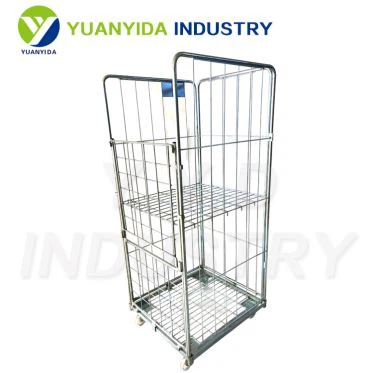
When you’re tired of dealing with bins that only work from one side, that don’t fit through your door, or that make lifting 2x harder, 2-sided roll containers aren’t “just another supply item”—they’re a small change that makes a big difference for your team, your bottom line, and even your shoppers, who won’t get stuck in aisles blocked by a bin full of soda. Give us a shout when you’re ready to talk, we’re here to help make your days a little less chaotic.
Portable Fence References
- Occupational Safety and Health Administration. (2022). Work-related musculoskeletal disorders in retail grocery. Washington, DC: U.S. Department of Labor.
- National Grocers Association. (2023). Supermarket operations efficiency report. Arlington, VA: National Grocers Association.
- Center for Healthy Retail. (2021). Warehouse and backroom safety in small supermarkets. New York, NY: New York University School of Global Public Health.
Qingdao Yuanyida Industrial and Trade Co., Ltd.
Qingdao Yuanyida Industrial and Trade Co., Ltd. is one of the most professional 2-sided roll container manufacturers and suppliers in China. Feel free to wholesale high quality and hot selling 2-sided roll container from our factory. There a wide selection of logistics trolleys at your choice. Also, customized service is available.
Address: Factory Add: No.1 Yunxing Rd, Yinghai Industrial Park, Jiaozhou, Qingdao, CHINA 266300
E-mail: info@qd-yuanyida.com
WebSite: https://www.yydindustry.com/
